The Word Prada's CEO Would Not Use
Andrea Guerra retired "aspirational" on camera. The replacement is a segmentation thesis.
What Happened
In a CNBC International interview published on 18 August 2026, Andrea Guerra was asked how crucial it is to build bridges to aspirational buyers, the customers priced out of a first bag and courted instead through beauty and eyewear. The Prada Group CEO answered by replacing the premise: "I would not call aspiration, I would call younger generation into luxury."
The Thesis
Aspiration defines a customer by distance. Generation defines a customer by time. Miu Miu held retail growth at 2.6% in Q2 2026 on top of a 40% comparison base, and the trade-off runs through the whole industry: solve for distance and you build tolls, solve for time and you build rooms.
Distance Builds Bridges. Time Builds Rooms.
The aspirational frame places the customer below the brand and prices the climb: an entry point, a lipstick, a pair of sunglasses. Every bridge product is a toll on the way up. The generational frame places the customer at a stage of life and asks the house to be present in it. Guerra's own example is Miu Miu, which he describes as genuinely inclusive across ages, a store where the mother and the daughter buy in the same place. Nobody in that room is on the way to anything.
The distinction is not vocabulary. A house builds what its vocabulary allows. Brands that segment by distance produce ladders and gatekeeping. Brands that segment by time produce belonging, and belonging is the only recruitment that does not expire when the customer arrives.
What Miu Miu Proves
The numbers behind Guerra's rename are already public. Miu Miu grew retail sales 2.4% in Q1 2026 against a comparison base of +60%, then 2.6% in Q2 against a base of +40%, for +2.5% across the half. Lapping the two hardest comps in luxury with growth intact is not a percentage cooling. It is a recruited generation staying. The group's own H1 release made the same reading in its own words, crediting "relevance and desirability" sustained against a still challenging comparison base, and management has named the second-half job as managing the brand's transition to a more normalised growth trajectory while preserving brand equity. The instrument is changing because the recruitment already happened.
Read It Either Way
If Guerra's word swap is just language, Miu Miu is a fortunate outlier and the bridge-product playbook stands. If it is strategy, much of the industry is still solving for distance while Prada is solving for time, and the entry categories the sector treats as recruitment are answering yesterday's question.
The Verdict
The number sits with the rename. At 2.6% stacked on 40%, Miu Miu is not traffic crossing a bridge. It is desire staying in the room that was built for it.
Rafael Carlesso reads where desire is built or lost, and writes the strategy that builds it. Writing from Milan. Quoted twice by Reuters on LVMH.
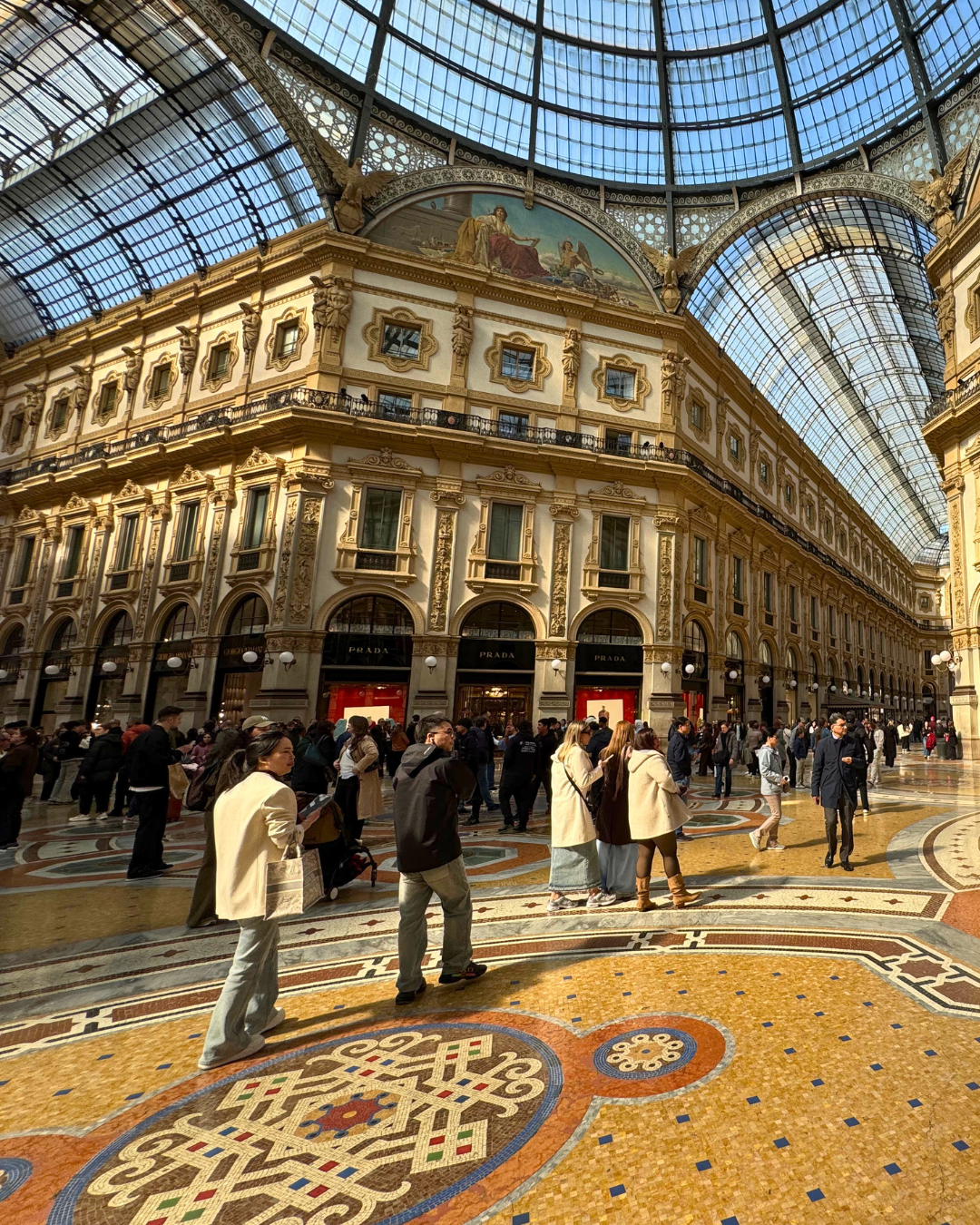
Photograph by the author. Galleria Vittorio Emanuele II, Milan, Italy.
You just read the verdict. Subscribers get what produces it: an Intelligence Brief on every house that reports, the Intelligence Reports that go deeper and stay open, revised as each marker returns, and The Desk, a written, fact-checked answer from me within two working days. Reuters has quoted this work twice this year. Put it to work in yours.